Sunday, 21 April 2019

The Gold Lane: Number 4

(SPOILER WARNING!!)

Horror is certainly an interesting film genre for me to talk about. One the one hand, we get plenty of chilling stories that leave the right kind of impact and scares to engage the audience without overstaying it's welcome. On the other hand, we have "Annabelle".

But I've already gone into detail to the complicated relationship I have with horror films, especially the idea of remakes So, I will instead just jump straight into talking about my favourite horror film of all time.

Number 4:

Image result for the thing 1981

John Carpenter's "The Thing".

I am not repeating the joke from my review of the awful prequel (shameless plug).

Released in 1982, "The Thing" is technically a remake of the 1951 Howard Hawks sci-fi/horror classic, "The Thing From Another World", though both are actually adaptations of the John Campbell Jr sci-fi novella "Who Goes There?" The commonality between all of these stories is an alien creature stalking a research team and picking them off one by one, but Carpenter's version is more faithful to the source material due to including characters from the book, being set in the south pole instead of the north pole, and the depiction of the creature being a word for word translation. The 1951 film is still good for its time, but I feel it took too many liberties with the source material and the head scientist is one of the dumbest fictional scientists ever.

But we aren't here to talk about the films authenticity as an adaptation of an 80 year old book. We're here to talk about what is, to date, my favourite horror movie.

Starting off, one of the aspects of this film that I greatly appreciate is something that most horror movies simply neglect; no-one in this film is a short sighted idiot. This is, sadly, a common troupe I see in a lot of bad horror movies, wherein the characters are so inexcusably stupid that it ruins any appreciation or agency for the story. They would often often the obvious choice and just resort to being incredibly short sighted, which results in them being seen as selfish jackasses who can't do the right thing when the situation calls for it. John Carpenter's "The Thing" is the complete antithesis to this. Due most of the crew being scientists, they know that they can't simply just rush in half-cocked. They analyse the situation and approach it once they have the evidence they need. Sure, they let themselves get emotional and sometimes act irrationally, but the story and setting actually justify these moments due to the films underlying themes of paranoia and mistrust.

Speaking of, said themes are used brilliantly to illustrate the danger of the situation these characters are in, and it's done simply through the visuals and great performances from the entire cast. Even simple things such as the wide exterior shots of Outpost 31 emphasises the feeling of isolation as well as showing how cold this place is. What also helps is that, much like the audience, the characters never know who's infected and who's human. This is true of the actual cast, as Carpenter would refuse to tell anyone who the creature is disguised as in the scene, which in turn makes the mystery all the more fascinating while we, as the spectator, find ourselves in the same position as our protagonists; who do we trust and who do we set on fire? Made even more interesting as we never actually see anyone get infected on-screen, which then leaves it to the viewers imagination as to how and when they became the creature, as well as whether or not they are aware of it.

But of course, it would be pointless to talk about this film without bringing up the visual effects, brought to the silver screen by a young Rob Bottin. Having worked with effects legend Rick Baker on other films, Bottin was only in his early 20's when he was hired by Carpenter to do the extensive effects, spending 57 weeks in the studio, day in/out, just to get these effects done on time with the budget that they had. And despite the backlash from critics, I really think that these effects serve as a reminder to the superiority of practical effects over CGI, especially when CG gets as bad as it does in the prequel. Bottin's work is disgusting, malformed and unbelievably creative. The way that the creature is able to look humanoid while still being a hideous eldritch monstrosity from your nightmares makes the alien one of the most visually horrifying horror movie monsters ever, on par with the Xenomorph and the Predator, especially when it starts to tear itself apart during the reveals. Take this scene when Palmer is revealed to be the creature, as an example:


Again, these effects where done when Bottin were in his early 20's. And yet, the way that Palmer's head just splits apart never comes off as a cheap effect. Extensively gory, yes, but that's part of the appeal of the effects, and it never comes off as being used to cover up any shortcomings from the production crew. It really is a shame that this film was a box office and critical flop upon release (though this can be blamed on timing as "E.T" was still in theatres and audiences were used to a "friendly looking" alien), as Bottin deserved a fucking accolade for his hard work.

Also, love the "TIED TO THIS FUCKING COUCH" moment to break the tension. Thanks, Garry!

A lot of what made a lot of these scenes more memorable is the almost total absence of music, the soundtrack itself being handled by Ennio Morricone, whom you might know from classics like "The Good, The Bad and The Ugly", "The Untouchables" and "The Hateful Eight". While the main score itself is, naturally, creepy and atmospheric, I'm actually glad that the soundtrack itself is hardly ever used throughout the film after the first half hour of the film. It adds to the overall suspense and the few times the score is used is when the action and the tension heightens. Even then, the music is mainly comprised of lower synth tones and deep bass as to not overshadow the impact of the scene.

Like any good musical score, it is instead used to emphasise the core themes and tone, adding to the overall nihilism felt throughout by the entire cast. To compare to the not-prequel, the music in that is not only bland and forgettable, but it is also used too often during the scenes that needed to be quiet, thus losing any and all terror it could've had while also making the audience more annoyed as they are forced to hear the same crap over and over again. Even the remix of the original theme for the not-prequel is ruined by the additions of people screaming in the background and (presumably) the creature roaring.

Just to compare, here's the original theme:


And here's the not-prequel's remix:


It's no contest. The original version wins. Fatality. Flawless victory.

I've gone into other details as to why this film is superior to the not-prequel, so I'll just wrap it up instead. This film has all of the best elements to make not just a great horror film, but a brilliant film in general. The effects, directing, acting and music all compliment Carpenter's style of filmmaking and allows the viewer to get sucked in with how the characters work off of each other, seamlessly balancing these elements with each other while still keeping a slow pace as to allow the suspense to build until the final shot. And thankfully, it was never ruined by ANY sequels whatsoever.
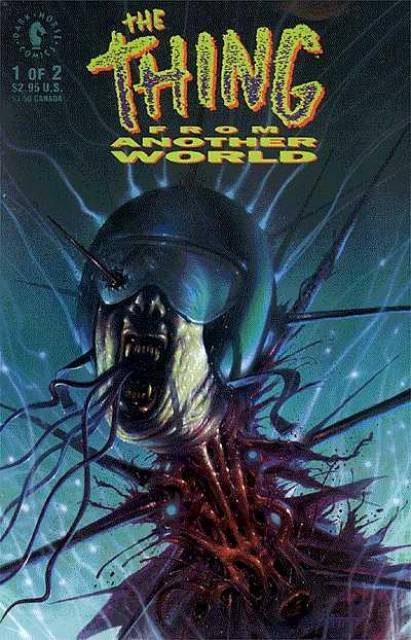
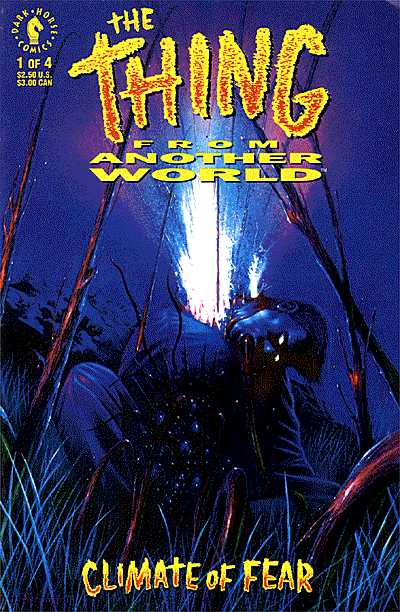
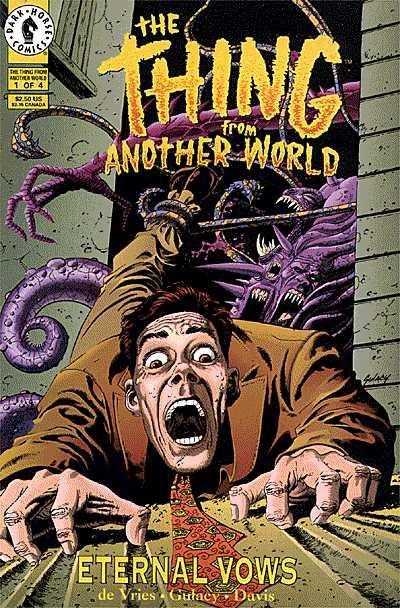
Image result for the thing from another world comicImage result for the thing from another world climate of fearImage result for the thing from another world eternal vows

ANY. SEQUELS. WHATSOEVER!

Overall rating: 9/10 (Excellent).

If you liked what you have read and want to see more, please leave a comment and share this review through social media; namely, through Twitter. I appreciate any word being spread about what I write. You can also follow me on Twitter @Media_Man18.

So until next time; this is Callum Lewis, the Media Hood, signing off.

Wednesday, 10 April 2019

The Gold Lane: Number 5

(SPOILER WARNING!!)

In celebration of my upcoming 50th post on Blogger, I will now be reviewing my Top 5 favourite films of all-time. However, I won't be leaving any hints about which film will be on the list. This will simply be a look back on what I consider the best films out there. They don't have to be the most well received or the best written; it simply has to be the films that help me in finding what I love in films. With that said, let us begin.

Number 5:

Image result for batman 1989

Tim Burton's "Batman".

And:

Image result for the dark knight

Christopher Nolan's "The Dark Knight".

Yes, for the first time since this little gig started, there's a tie as I can't decide which one is better, so they're both in the same spot. Also, this is my list and I do what I want.

Part of the appeal of the character of Batman in film is the various the character can be depicted. While nowadays every version of Batman is dark and serious, there was a time before the 80s where Batman wasn't taken as seriously as he is now. Due to the way that people used to look at comic book heroes, no-one really looked at Batman beyond the Adam West show of the 60s. As such, when the character took a darker turn with the likes of "Death in the Family", "Batman:Year One", "The Killing Joke" and "The Dark Knight Returns", this is when people realised the potential of how to portray the character in other means. Enter visionary director Tim Burton and actor Michael Keaton with a new version of a live-action Batman that took more inspiration from those stories than the version saw in the 60s. It was a shocking change, but not an unwelcome one.

Then, of course, things changed with this depiction of the character becoming increasingly popular in comics and TV over the course of the 90s in "Batman: The Animated Series" starring Kevin Conroy and the early 2000s where the character would be rebooted in film starting with "Batman Begins", brought to live by Christopher Nolan and starring Christian Bale in the lead role. And while that film was a great return to a darker adaptation of the character and his origins, it still felt like small potatoes in comparison with it's 2008 sequel; "The Dark Knight".

Both the Burton version and the Nolan version has had the largest impact on the mythos in popular culture in recent years, bringing the best of the character to the screen in greatly different ways. The Burton version is more surrounded in atmosphere and mystery, while Nolan's is focused more on moral dilemmas and the consequences of the characters actions. Burton's film is a classic action packed comic book movie, whereas Nolan's feels more like a social drama with a vigilante. Whether which one captures the character and his conflicts the most effectively over the other is still up to debate, but this is more of a focus on what makes these films work for me. So let's get started with the Burton film.

Part of what makes the Burton film work is the visual style. This film arguably has the best looking version of Gotham in any version of the Batman story. There is a slick combination of Gothic architecture and (then) modern technology, making the city look timeless while still creating a dark atmosphere that permeates every nook and cranny of the city. Granted, some of the buildings like the church used for the final confrontation are obviously small scale models made to look large, but it doesn't take away from the overall beauty of the scenery, which is then complimented by Burton's tight and concise direction to make the film more visually appealing despite most of the film looking grey.

The performances from everyone, especially Keaton as Bruce "Goddamn Batman" Wayne and Jack Nicholson as The Joker, are excellent, with no-one ever feeling out of place. The irony with Keaton is that fans weren't initially excited to see him in the role, petitioning to have him replaced. But that inability to suspect him as Batman is the reason why he's perfect; Batman needs to be mysterious and unpredictable, thus characters in the film need to be surprised when we learn Bruce is the dark knight himself. When he's trying to explain himself to Kim Bassinger's Vicki Vale about what he does at night, he's able to sell it because of how surprisingly normal he acts. This contrasts perfectly with Nicholson's Joker, who is simply perfect for the role. He's creepy and eccentric, while also being incredible funny and entertaining to watch. I actually remember laughing when he starts pining for Vicki and goes to extreme lengths to get her in his pants, mainly because of how Nicholson acts as The Joker. Really, aside from Mark Hamill, Nicholson was pretty much the definitive version of The Joker for the longest time. Here's hoping, then, that Joaquin Phoenix does a good job with the character this coming October.

Danny Elfman's score, as expected, is simply amazing. The orchestra captures both the subtle brooding nature of Batman while also having more upbeat and faster music to accompany the various fight scenes scattered throughout the film. The choir just makes everything the characters have more weight to it. The fights themselves, while obviously being limited by the films budget, are still well choreographed and directed to give each fight a sense of excitement and importance.

It really is the acting from the entire cast and the scenery dripping with the perfect atmosphere that makes this not just one of my favourite super hero films, but one my favourite films of all time.

But of course, there's another version that actually rivals it; Nolan's version.

Much like the Burton film, the focus of the film is on the rise of The Joker and his conflict with Batman. However, there is something of a role reversal. In the Burton film, we knew little about Bruce's past and his path to become Batman, whereas we knew how Jack became The Joker through the narrative. In "The Dark Knight", we already know everything about Bruce while never knowing how The Joker became the way he is. Frankly, either way is effective as we become more invested in the character due to the mystery of their origins. In the case of "The Dark Knight", it works in favour with Heath Ledger's Joker because that add to the characters' unpredictability, especially when he starts telling different versions of the story of him getting his scars. It's never made clear about which story he tells is true, but that was intentional as a means of never fully understanding what makes him tick. All that we know about him in this film is that he wants to spread chaos and anarchy, which is terrifying in and of itself. With The Joker constantly putting people in a situation where they have to make moral decisions without losing who they are, it thus helps to establish him as a more serious threat. Ledger's surprisingly fantastic performance makes his version of The Joker one of the best villains in recent cinematic history, on par with Darth Vader and Thanos.

One of the critiques of "Batman Begins" was the obnoxious shaky cam and rapid fire editing that made it hard to follow the action scenes, leading it to be a visually jumbled mess. Thankfully, Nolan has rectified that mistake and now, the cinematography and directing and far more smooth and dynamic, making an everyday city like Chicago standing in for Gotham feel more alive and vital to the story. This in turn makes the action scenes far more intense, as Hans Zimmer's music and tight writing keeps the atmosphere building up and up to the inevitable stand off between our hero and villain.

The story arc with Harvey "Two-Face" Dent is handled very well and ties back to the films main theme of moral and emotional compromise. Harvey is presented throughout the film is a shining beacon for the people of Gotham to idolise, but we still see his machinations with him still willing to cross the line if it means pursuing what he considers to be fair and just. This is what makes his friendship with Bruce and conflict with Batman more fascinating to witness. He may not be as tragic or depressing as when presented in B:TAS, but he still has that emotional depth that is needed to make him a stand-out feature of the film. Part of me wishes they would get Aaron Eckhart to play the character in other Batman films. Maybe not the same version we see in this film as (SPOILERS!!) he dies at the end, but he still embodies what makes the character one of Batman's greatest adversaries.

Frankly, the only complaint I can lobby against the film is, oddly, with Batman himself. This isn't so much a complaint about the writing for the character, but more so about Christian Bale's performance. I never really bought him as Batman, which is to be expected with that silly looking costume and, of course, the voice:


But even ignoring that, I simply never believed him as Bruce Wayne. In this one, I'm surprised that even the most brain dead of criminals couldn't piece together that Bruce was Batman due to how he always acts like he has something to hide from people, and how he just disappears in the middle of a big event only for Batman to show up. The appeal of Bruce Wayne is that he is meant to be so good at hiding his identity of Batman that no-one, not even those closest to him, could ever figure out the truth unless he told them. Yes, there were people who discovered his secret; Tim Drake and Hugo Strange, just to name a couple. But Bruce was still able to hide it from people due to a swaggering philanthropist with a pair of gorgeous women by his arms. Keaton captured this perfectly with how he acted with such natural charisma that no-one ever thought he could be this terrifying creature of the night. Bale, on the other hand, makes it obvious to practically everyone that he's hiding something. I don't hate Bale in the role, I just don't think he was the best casting decision.

Ultimately, that is my only real critique with "The Dark Knight", as it is otherwise a legitimately solid film. And between these two Batman movies, there is the perfect Batman film. Just take the chaotic nature of The Joker and the moral dilemmas from "The Dark Knight" and combine it with the atmosphere and Keaton's performance from "Batman", and you have yourself the quintessential Batman film for the ages.

But as is, these are still two incredible comic books films that I cannot recommend enough.

And hey, at least there's no Jared Leto to be seen.

Overall rating for both: 9/10 (Excellent).

If you liked what you've read, then please follow me on Twitter; that's @Media_Man18 on Twitter. And please, share this review on social media, whether it's Facebook, Twitter, Tumblr, etc.

So until next time; this is Callum Lewis, the Media Hood, signing off!

Oh! And before I forget:

Tuesday, 9 April 2019

Kamen Rider Gaim (2013-2014)

(SPOILER WARNING!!)

I will admit to not being a Kamen Rider fan for the longest time. Bare minimum, I've been a fan since 2014 when I first watched Kamen Rider W on YouTube. However, W was not the first time I've heard of Kamen Rider. That was actually through OOO, which I saw first. W is just the first one I've watched all the way through, and I personally preferred W over OOO. But of course, there was one particular series that EVERY Kamen Rider fan simply would not shut up about, and for good reason:


When I had first heard about Kamen Rider Gaim, I was... interested, to say the least. The main motif is fruit? The hero looks like a samurai? Part of the story revolves around dancing? What were they smoking to come up with stuff like this?

Again, this was during a time in which I was brand new to the franchise and thus, wasn't aware of other series that were somehow stranger in some aspects, as well as not fully grasping the core fundamentals of Kamen Rider due to my lack of experience. But having now watched 15 of the 20 instalments in the Heisei era all the way through (dropped Zi-O and still need to watch Agito, Ryuki, Blade and Hibiki's first half), 36 episodes of Black and at least half of the original adventures of Takeshi Hongo and Hayato Ichimonji, I think this has actually helped me appreciate Gaim even more upon reflection. I can easily see why many fans declare one of the best series since Black, as well as one of the best of the soon ending Heisei era.

Anyways, this series was mainly written by Gen Urobuchi, who got his foot in the door with Puella Madoka Majica (haven't watched) and a couple of entries in the Type-Moon Anime (haven't watched either). But if his writing in those series is anything like what we see in Gaim, then I think I'll be emotionally scarred for life while still enjoying the content overall. Then again, I'm not really an Anime guy, so who knows if I'll ever check those shows out.

Regardless, the story is set in Zawame City, a town primarily run by the multi-platform conglomerate Yggdrasill. This town has a bizarre connection to a pocket dimension full of monsters known as the Helheim forest, wherein said monsters, the Invess, feast on an alien fruit to grow in strength, though the fruit has an unfortunate side effect of turning normal people who consume it into monsters. Yggdrasill use what they have studied of the Helheim forest to create a series of counter-measures to prevent the forest from slowly, but surely, consuming the world; chiefly, a series of belts that harness the powers of Lockseeds to give their wielder power and armour to fight back. Enter out protagonist, Kouta Kazuraba, who at first uses the belt for his own ends but soon starts using it to protect the people of Zawame from the Invess, but also starts to discover not everything is black and white with Yggdrasill either.

However, more people get their hands on Sengoku Drivers, and each on has their own end goals in mind; there's Kaito Kumon, Kouta's main rival, who believes in the survival of the fittest so that the weak would no longer suffer, Kouta's best friend Mitsuzane "Micchy" Kureshima, who starts to become more cold and calculative with his actions leading him to slowly go insane with his megalomania (becoming the most hated Kamen Rider character since Masato Kusaka), and Micchy's older brother Takatora(bata), head of Yggdrasill, who seeks to purge the world of Invess no matter the cost. And that's just to name three out of the literal dozens of Riders in this show. And in the mist of all of the conflict between the Riders is the Golden Fruit, the main power in the Helheim forest that allows it's user to either reshape the world in their image, or completely destroy it.

Admittedly, like other Rider series, the story does take a while to get going. But the best Rider shows, in my opinion, use the slow start for character development and setting up the mystery behind the antagonists. W did this with the Sonozaki family and their connection to the Gaia Library. OOO did this with Dr Maki and his eventual turn from secondary character to main antagonist. Even Ex-Aid did something similar with Dan Masumune being a surprise villain, namely how he was originally just a minor character before it was revealed that he was as maniacal as SHIN DAN KUROTO SHIN, just in a different way.

However, one of the critiques that I have for this show is that it doesn't always knows how to use it's cast effectively, and I blame that on there being SO many additional Riders in this show. On top of the main four of Kouta/Gaim, Kaito/Baron, Micchy/Ryugen and Takatora/Zangetsu, there is also Ryoji Hase/Kurokage and Hideyasu Jonouchi/Gridon, a pair who start off as run of the mill throwaway antagonists who are just out for popularity. Granted, Hase does have some relevance to the main storyline for episode 14, which in and of itself is a dark episode, but he otherwise has little character to him beyond a jackass who just wants power. That's not even getting into the likes of Zack/Knuckle, whose character arc is so minor I pretty much missed it on my first viewing and we don't really get to know him until his own spin-off set after the series had ended. The only secondary Rider I found myself caring for was Oren Pierre Alfonzo/Bravo, but a lot of that was from how flamboyantly over the top he was. Everything he does is done with exuberant passion and a willingness to embrace both his pride and his shame, which is something I can look up to, especially when he takes in Jonouchi as an apprentice both as a Rider and as a young patissiere... yes, really.


He kind of reminds me of what could happen if Mettaton fused with Gordon Ramsay and decided to become a Kamen Rider. It's just the right kind of batshit crazy imagery I love in Tokusatsu.

That said, I still found myself really getting engaged with the main four themselves. I loved watching Kouta slowly discovering for himself what he has to fight for, as well as how it would reinforce his actions in the rest of the series. Micchy's turn from underdog hero to sociopathic manipulator was a fascinating change of pace for a secondary Rider, especially when he does it all for a woman who he knows will never return his affections. Takatora's actions may seem inherently villainous at first, but there is a twisted logic behind it all, which makes him a far more interesting antagonistic force for Kouta to overcome. He reminds me of Thanos in a way; in that he is sacrificing lives as a means of preserving the rest for the sake of survival. Kaito's motivations may not be fully explored, but he more than makes up for it by actually showing respect for those who fight for their worldview, no matter how much they may conflict with his. The key idea that ties all four of them together is that, whether you agree with them or not, you understand exactly where they are coming from and how that affects their character, which makes their underlying conflict all the more fascinating.

Image result for gaim orange arms

I love the costumes in this series, as each of them have a distinct quirk that help them stand out from any other Rider suit in the franchise. Namely, the main seven Riders (Gaim, Baron, Ryugen, Zangetsu/Shin, Kurokage, Gridon and Bravo) are each based on a different warrior uniform. Gaim and Zangetsu on Feudal era samurai, Baron on a European knight, Ryugen on a Chinese warrior (while also having a dragon motif), Kurokage on an armoured ninja, Gridon on a Roman centurion, and Bravo on a gladiator (my personal favourite). Despite some shared elements between them, each of these fit the characters personalities to a T and gives each one a unique identity. It helps that the fruit-themed Lockseed armour is not overbearing with it's motif and helps to keep the costumes, even extreme ones like Bravo Durian Arms, streamlined and easy on the eyes.

The fights, even when Osamu Kaneda does a few episodes, are excellently choreographed, which is to be expected when Seiji Takaiwa is underneath all of that armour and presenting Gaim with so much personality. This man has been the suit actor for almost every lead Rider in this Heisei run and he brings these otherwise blank slates to life with such simple gestures and postures. And more importantly, the fights in the series work with how they build off of each other through the narrative context of why they are even happening, which thus always keep the audience invested in the outcome. This is especially true for when the Riders fight each other. While this is obviously taking inspiration from Ryuki, I can already tell that it is handled FAR better with how each of the characters motivations are easy to understand and in no way tear apart the narrative, which adds to the indecision of who to root for when they fight. I really do wish that series that handle Rider conflicts would take note from Gaim, as it actually makes it work here.

The music is some of the best in the franchise, with the basic background score helping the flow of the narrative feel more smooth and natural while also conveying the shows main thematic motif of conflict and dividing paths. This is arguably most prevalent in what is easily the best final form insert song I've heard in Kamen Rider; Ranbu Escalation.


Sung by Gaku Sano and Yutaka Kobayashi (the actors for Kouta and Kaito, respectively), this song captures the emotional struggle between the two perfectly. Kouta is trying to show his resolve to change the fate of the world while still holding on to his beliefs and humanity, while Kaito's ideals of survival of the fittest is what drives him to rid anyone of weakness, even if it must cost him what makes him truly human. Two perfectly understandable motivations and ideals that give these characters more depth and identity. Thus, when presented in Ranbu Escalation, it becomes less of a final form song for Gaim Kiwami Arms, and more of a perfect encapsulation of the shows main conflict. This is the kind of emotional complexity that I miss in more current final form songs (bar Ghost with no insert themes, or Zi-O's music simply sucking), which simply default to "My resolve is strong and I will kick your ass". Those songs are fine, but they never really seem to capture the emotional depth that is needed to carry the scene where they are introduced. Ranbu Escalation, I feel, is the last truly perfect final form song.

But of course, being a Gen Urobuchi series, it has to start off relatively light hearted before going into some legitimately dark places. Keep in mind, the first ten episodes are mainly about a bunch of dance groups competing for different stages and Lockseeds to get the highest points. When the mid-teens hit, however, it goes dark and FAST. Episode 14 is focused around Hase becoming an Invess and Kouta is conflicted about stopping him without killing him, as it is still Hase inside of that mindless monster. But this isn't something that's resolved by the end of the episode; the Energy Riders come in and KILL Hase right in front of Kouta. Suddenly, it hits you; this is not going to be a standard "victim of the week" style series; this is going to be a tragic, emotionally scarring journey for the protagonist as he tries to pick himself up from all of this.

Hell, here's another example. The first Invess that Kouta kills as Gaim? It's later revealed that it was Kouta's friend, Yuuya, after he ate a Helheim fruit upon entering the forest with a Sengoku Driver. And when Kouta finds this out, he is completely torn apart at this revelation. He's in tears, he doesn't know what to do know; he's realising that the powers he has used to protect people has took away the life of one of his best friends. This, in turn, gives way for his growth to be a rallying point for those who can't fight for themselves, as well as striving to redeem himself for the mistakes he has made as an endeavour to never to make those mistakes again. This is what made Kouta one of my favourite Rider protagonists, with how his growth and maturation throughout the show comes naturally and is never an excuse to sell a gimmick.

Kamen Rider Gaim is easily in my Top 5 Kamen Rider series of all time. While I can understand why some people may not have bought into it initially, the show won myself and others over very quickly with it's surprising maturity and emotional complexity, complimented by excellent musical scoring and wonderfully choreographed fight scenes. But it still remembers that at heart, it's a show that anyone and everyone can watch without ever feeling like it's talking down to it's audience or trying to scare the shit out of them. Much like W, it's essentially a deconstruction and further reconstruction of what makes the franchise enjoyable. And no amount of shoddy spin-off material or awful series that don't understand it's legacy can take it away.

Overall rating: 9/10 (Excellent).

I would like to thank everyone for taking part in the voting poll and choosing this as the next thing to review. If you like what you've read, please consider following me on Twitter and leaving a comment. I also appreciate it if this review gets a retweet, spreading the word really helps.

When next we meet, I will be counting down my Top 5 favourite films of all time. No hints, this time.

So until next time; this is Callum Lewis, the Media Hood, signing off!

Monday, 1 April 2019

What to review next?

Well, I've been hit with a familiar feeling; WRITER'S BLOCK!

For some time now, I've been having issues with what I want to review next. Despite all of the things I have at my disposal, I have been stuck deciding which one to take a look at. That may be the main reason as to why I've been shoving out reviews of Transformers related material because it was simply the easiest to talk about at the time.

Thus, at the risk of getting mixed results, I'm starting a "poll" of sorts. I am giving you, yes, YOU the chance to decide what I review next. Simply leave a comment on this blog or a comment on the tweet and by the 8th of April, the results will be in and the choice will be made. So please, decide between these 5 options:

1. Doom (2016).

2. Rurouni Kenshin (2012).

3. Kamen Rider Gaim (2013-2014).

4. Original Khan vs Kelvin-verse Khan.

5. The Golden 5 (a.k.a: Top 5 Favourite Films of all time).

Simply choose from one of these 5 (or, technically 9?) options. Comment below and let me know!

I also appreciate a retweet to spread this out as far as possible to get as many answers as possible, and please follow me on Twitter if you want to see more.

So until next time; this is Callum Lewis, the Media Hood, signing off!

Sunday, 31 March 2019

Star Trek Episodes 1-3 (excluding the original pilot)

(Spoiler warning for a show older than my parents!!)

Although I was always aware of Star Trek, I never really took the time to get into it. I think it was because by the time I learned about the franchise, the "Kelvin Timeline" was kicking off in 2009 and I originally thought that it would be a Star Wars copy. Shows how little my nerd cred really matters, doesn't it? I've watched the Kelvin-verse and enjoyed it fine (Into Darkness, notwithstanding), and when I finally sat through Wrath of Khan I really enjoyed it. I knew nothing of the original cast beyond a few cameo appearances in Simpsons and Futurama, but I found myself enjoying what I had seen nonetheless.

So, when I heard that Star Trek: Discovery was coming out, I felt a compulsion to finally check out the original series... then that compulsion disappeared until a week ago where I found all of the shows (but none of the films) available on Netflix and wrote down the chronological order of which to watch. The first, of course, would be the original in 1966 starring William Shatner, Leonard Nimoy, DeForest Kelly:


This will just a brief recount of the first three episodes (again, excluding the pilot) and keep in mind, this is from a fresh perspective of someone who isn't the biggest fan of the franchise (as of right now, at least). So, if I say anything about a story point not making sense or wishing more could be done with it, don't bother saying if it makes sense in another show or is expanded upon because as of right now, I just do not care. I want to be able to experience the show as is and give my critiques as I go along. No idea if I'll do this for every 5 episodes, but I do at least want to cover the series up to "Space Seed" if only to see how Khan was introduced.

With all of that said, let us begin with:

"The Man Trap!"

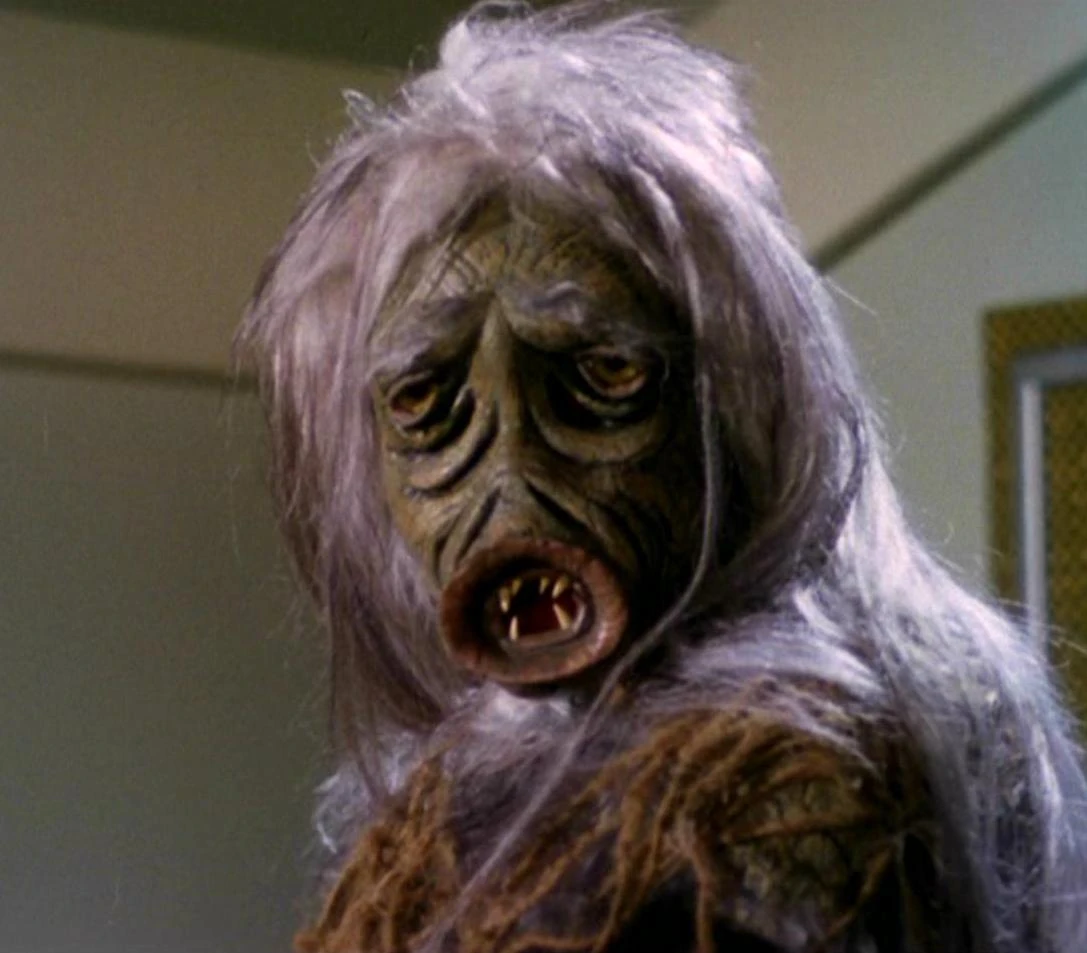
Image result for the man trap star trek

Yes, those are really the legit effects of the time. I still defend it due to the show having a shoestring budget.

Anyways, this episode first sees the crew of the Starship Enterprise doing a routine medical check on planet M-113 with Dr Crater and his wife Nancy, whom was originally an old flame for Dr Leonard McCoy, only for a random crew member to get killed off (a running gag so famous even Trekkies make fun of it) by an unforeseen creature. They learn he died from having his sodium chloride levels sucked out, which leads the crew to believe that Crater and Nancy are hiding something.

As first episodes go, this one was fairly decent. I enjoyed seeing the personalities of the cast bounce off of each other, especially McCoy's cynical attitude complimenting Kirk's cockiness and confidence. The mystery behind the deaths of the crew members, while somewhat predictable, was engaging with how no-one was shown to be stupid, though it does get personal when Nancy gets involved and McCoy gets defensive on her behalf. While it is very easy to poke fun at the acting in this show, particularly Shatner with his odd inflections, the performances from the entire main cast is still solid and we can see the beginnings of the defining traits these characters would possess during their time. Frankly, my main complaint is that the twist is a bit too predictable. Without getting into spoilers, you can tell what the twist is as soon as Nancy finds the first dead body. Otherwise, a decent start to the show.

A pity that it is then followed by an awful episode with a broken premise:

"Charlie X".

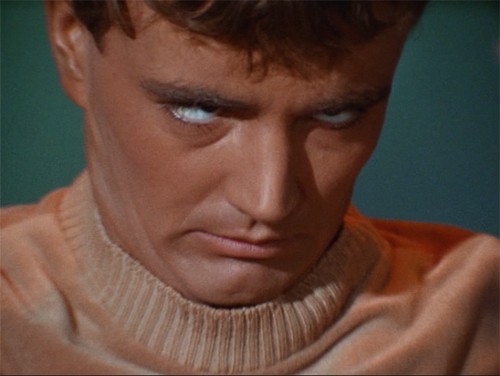
Image result for charlie x star trek

Oddly, that's the same face I made for the entire episode.

As for the plot, the crew of the Starship Antares--

Image result for antares .hack

-- No relation to him, drop off a 17 year old boy, Charlie Evans, in the hands of the Enterprise, happy to just get rid of him. As the episode progresses, we VERY quickly understand why; the boy has psychic powers, and he has been using them on people without any remorse or hesitation. He was apparently raised and educated by a computer, which has left him so socially inept, that he hates the idea of someone not being friends with him and would use his powers to torture them, just because they weren't nice to him; doing so to the Antares by making it explode off-screen later in the episode.

And thus, why this premise does not work; they try to make us feel sorry for Charlie because he hasn't had a normal upbringing and hasn't, supposedly, been taught right or wrong. I argue, however, that he clearly DOES know the difference between right or wrong, with how he uses his powers with unfiltered joy to fuck around with the very fabric of reality itself; chiefly by turning people he doesn't like into animals, muting Uhura when she sings, forcing Spock to recite human poetry to amuse him, teleports people into space, thus likely killing them, and forcing Kirk to keep a ship on course just so he can meet new people to torment. Correct me if I'm wrong, but that doesn't read at all like a kid with social anxieties and an uncontrollable power, but a relentless sociopath who takes pleasure in the torturing of others. He may has well be a descendent of Onision, because that's all I got out of it.

I'm sorry if I don't talk much else about this episode, but I seriously cannot express enough why this episode pissed me off. So, if it's okay, I would like to move past it now and talk about the next one:

"Where No Man Has Gone Before".

Image result for where no man has gone before

"Come play with us, Shatner."

Upon finding a damaged recorder from a lost ship and after going through the same magnetic storm that caused it to be lost in the first place, Helmsman Mitchell and psychiatrist Elizabeth are both affected and end up with incredible ESP powers, the former becoming insane from his new godlike abilities. Thus, Kirk has to decide whether to kill this old friend that is only now being introduced and is never mentioned again, or save the entire crew from the same phenomenon that killed the previous one of the lost ship.

Frankly, while this episode is better than the previous one, it's still kind of boring. Most of it is just having Mitchell and Elizabeth laying around in the med-bay doing nothing, while occasionally cutting to the crew just pondering on what to do next. Really, most of the episode could be summed up like this:


Well, minus the part about them being idiots, but you get my point. Very little actually happens during the episodes length to really justify being 50+ minutes long. We don't really get to know Mitchell or Elizabeth as people, either, so I don't really care for their ultimate fate by the end. It's still competently written so it doesn't annoy me, but it still could've been a lot better.

But for now, I will still keep watching the series as is. No clue if I will keep updating and giving my raw thoughts on the episodes as I go (I'm up to episode 7, mind you), but it'll still be an interesting ride nonetheless.

If you liked what you've read, then please consider following me on Twitter, as this will be retweeted to get it out there. If you have any thoughts, please leave a comment; I'd love to see you defend Charlie as a character.

So until next time; this is Callum Lewis, the Media Hood, signing off!

Monday, 25 March 2019

What I want to see in a new Transformers movie series

(Spoiler warning, I guess?)

No matter how I much I am trying to keep this blog diverse, I just keep coming back to Transformers. I guess Bumblebee really did reinvigorate my love for the franchise as a whole.

That said, I think most fans can agree that the film series that we have gotten prior to Bumblebee has been pretty... divisive, shall we say. In spite of each film after the first getting worse critical reception, even from audiences, there were still people who suckered up and kept giving the films millions, if not billions, at the box office with each release. That is, until The Last Knight came along and people just got sick of these films constantly popping up every 2-3 years to bash their brains in with a Bay-coated sledgehammer. And as I have brought up before in several of my posts on Transformers, even I, the guy who used to defend these movies with every fibre in his body; even I got sick of defending the films with how they would get disastrously worse with each rewatch. It was basically the antithesis of watching Hot Fuzz (or any of the Cornetto Trilogy, for that matter).

This is why I am happy that Bumblebee was a hit with audiences and actually turned a profit as well, which is also allowing for a new cinematic universe to start from scratch. All of the lingering plot threads from the Bayverse are now completely gone and the series can reset with a new take that is more faithful and honest with the fandom. I am legitimately pumped to see an entire film take place on Cybertron, or having a film dedicated to Optimus Prime that isn't showing him as a murderous psychopath. I want to see these characters that myself and many others have come to love over the years, and for the films to really give the fans what they deserve.

That said, I still have my own ideas as to what I want in the new series of films. This isn't so much a prediction of what MAY come, but rather just a general list of things that I would love to see done in love action. And I suppose the obvious place to start would be:

1.


Keep in mind, while Beast Wars and Beast Machines was airing while I was growing up, I was born in 1996, the same year that Beast Wars premiered. Thus, I was far too young to get into watching Transformers. But of course, as a modern Transformers fan, I eventually found the entire series on YouTube (before copyright took it down and I refuse to get the Region 1 coded boxsets on Amazon [because they are stupid expensive and Region Coding is a fucking joke]) and fell in love with the story, and the characters, and the voice acting, and the references to G1, and the anima-- actually, not so much the animation, but I still loved watching Beast Wars the whole way through. This is probably why I really want to see a new version of Beast Wars brought to the big screen. Not so much a reboot or just the same thing with prettier CG animation; rather, a re-imagining of the series that still uses the elements that made Beast Wars worked so well. Besides, it also works as an ample chance to expand on the cinematic universe they are now building and the business opportunity for brand new toys based on timeless characters.

Just bring back Scott McNeil for either Rattrap, Dinobot or Waspinator, and a Beast Wars film could work in this new series of films.

2. Incorporating elements from other series.

While people may have their favourite Transformers seasons and while others simply refuse to watch anything that ISN'T G1, I am still hoping that this new line of films will incorporate elements from other seasons while still remaining faithful to the heart of the overall franchise. When you get down to it, the original G1 cartoon had very little in terms of actual lore until season 3, and even then it was more about exposition details of how the Transformers were made, less so any historical lore or mythos behind it. Other versions like Prime or the Marvel Comics added more to the mythology and took things in a newer direction, while still being influenced from past works. Even the Bayverse tried this with Age of Extinction and, to a lesser extent, The Last Knight. They botched it, yes, but they still did it nonetheless. I want to see this new lines of films do the same. Maybe include stuff like combiners, or the mythology of Unicron, Primus and the Original 13.

Heck, with how storytelling has evolved for the franchise as a whole, one could easily do a newer interpretation of Megatron and how his cause started, maybe even draw on the version from the IDW comics as a mistreated lower class miner who had no choice but to resort to violence when his words were never enough. That would automatically make that Megatron FAR more interesting than what was seen in all 5 Bayverse films put together. The same could easily be done for the whole Orion Pax/Optimus Prime backstory to help give the character more nuance in film and make the conflict between Optimus and Megatron more personal.  Maybe even do what other material from IDW has done and have both Autobots and Decepticons who walk a morally grey path, or even ones who never wanted war in the first place. That would be an interesting talking point for the films, maybe have one focused on a group of Neutrals who try to remain out of the conflict. That is something that is almost NEVER addressed in any Transformers media.

3. Shattered Glass.

Anyone familiar with the "Mirror, Mirror" concept from Star Trek knows the possibilities that arise from such a simple setting; a universe where the roles are reversed between the heroes and the villains. While not explored as often as one would think, the Transformers equivalent, Shattered Glass, still opens the potential for a fascinating story-telling engine to be brought to the franchise outside of the comics for the first time. And from what I have heard, we almost had that in 2010. Before Transformers: Animated was confirmed to be cancelled before Season 4 could be put into production, one of the episode ideas would've focused on Bulkhead and Sari being transported to an alternate universe where they have to hid from the dictatorship set up by the Autobots, while forming an uneasy alliance with the rebellious Decepticons. The possibilities from such as set-up basically writes itself.

Really think about it: a universe where Optimus demonises Megatron and his friends as terrorists and starting a civil war for the sake of becoming a Prime; where Starscream is a caring, compassionate, honour bound warrior who believes that Megatron deserves to lead Cybertron to a new Golden Age; where Drift could finally embrace that he is the Transformers equivalent to Deadpool; where Michael Bay makes Oscar-winning political dramas. Okay, that last one requires a miracle that only Primus could grant, but my point remains. They have the free reigns to do what they want with this setting, so they can go all out with it. It's gotta more interesting than most Fanfics that just retell the same story just with the roles reversed.

4. Creating a new mythos.

While I would love to see these classic stories brought to the big screen, part of why the franchise has lasted for almost 35 years is how the best seasons bring something new to the table. The Marvel Comics took the same story as the cartoon and put a different spin on it. Beast Wars/Machines brought in the idea of techno-organics and the descendants of both factions continuing the struggle.  The Unicron Trilogy, even with as bad as Armada and Energon got, established the Mini-Cons as a new faction and expanded a bit on the mythology of Unicron and Primus. Animated was a celebration of the franchise and put new spins on classic legacy characters. War For/Fall of Cybertron was a darker retelling of G1 that focused more on how Cybertron fell apart by the seams, as well as the escalation of Megatron as a threat and a truly powerful presence as a villain. Even the IDW comics had the beginnings of the war based on political struggles and the Decepticons being more of a fanatic cult than a terrorist faction.

Each of the best series, even when they tell the same story over and over, was able to bring something fresh and creative, whether it was new addition to the mythos or a different spin on an old concept. These new films could do the same if they keep it up and use the Bumblebee movie as a starting point. Again, they could go all out with these ideas and bring something new to the movie-going audience that will, ergo, keep bringing them back film after film.

The main point I am making here is that I want the series to keep growing and evolving, whether it's in the cartoons, the comics, maybe some games, and, of course, the films. For the longest time before Bumblebee got to the big screen, people were getting tired of the movies just doing the same thing again and again, to the point where The Last Knight lost the studio $100 million at the box office and the critical reception was at an all time low for the films. So, seeing Bumblebee get the films out of the gutter and breathe life into the series was exactly what fans needed to feel in any way optimistic about the future of the franchise. I want to see them do something new and bring fresh ideas to the films to keep things going. Don't go back to the way things were when Bay was in the directors chair; let the fans feel like they're getting what they asked for and the respect that they deserve.

Still, this is what I hope could happen with the films. It might happen, it might not. If anyone reading this has their own ideas for what could done with the movies, please let me know. And if you like what you've read, please follow me on Twitter; I share these reviews on there all the time and I always appreciate a retweet.

So until next time; this is Callum Lewis, the Media Hood, signing off.

Saturday, 23 March 2019

Kishiryu Sentai Ryusoulger Ep 1: Que Boom!!

(SPOILER WARNING!!)

You would think someone who keeps saying he doesn't watch Sentai would stop talking about Sentai. But with new seasons for Power Rangers and Super Sentai now airing at the same on both sides of the planet, and both getting a lot of attention from fans, it would make sense to talk about what Japan cooked up after cops and robbers (not really). This year, we now have dinosaur knights and YouTube vloggers... wait what?


Okay, there is more to it then that, so let's break it down. In present day, a trio of... teenagers(?) are chosen after years of training to carry on the legacy of their masters; the descendants of the Ryusoul tribe from 65 million years ago. In the past, the knights of the Ryusoul tribe faced off against the Druidon tribe, only for the asteroid that caused the extinction of the dinosaurs to force the the Druidons off planet. The modern day trio, consisting of Ryusoul Red Koh, Ryusoul Blue Melto and Ryusoul Pink Asuna, are more than ready to defend their home from any threat, only for the Druidon to return and wreck havoc, leading to the deaths of the trios masters, the destruction of their original source of power and a giant monster begins attacking their valley. With this threat now looming over them and through the power of their own souls, the new team of Ryusoulgers must find their mechs, the Kishiryu, and reunite with Ryusouls Green and Black so that they may stand a chance of saving the world.

Oh, and Koh becomes associated with a YouTuber named Ui Tatsui who seems to be a mouthpiece for calling out Logan Paul for going into the Aokigahara forest to find a dead body... more on that later.

This first episode already has the makings for a pretty good series; one that focuses heavily on the true valour and nobility that comes with being a knight, with the heroes explicitly said to draw their power from the strength of their souls. And thankfully, unlike Zyuranger, the use of the "super ancient civilisation" troupe doesn't really break the setting (though one could certainly make the case of how it conflicts with Kyoryuger's setting), but instead helps to reinforce the idea of the continuation of a lineage of warriors who swear to protect the innocent like the knights of Arthurian legend.

On a side note, am I the only one who finds it strange that this show is themed around knights while Kamen Rider Zi-O has it's main "hero" trying to become a king at the same time (the latter is dumber in this regard)?

Aesthetics wise, I really enjoy the costumes and effects for this show thus far. The suits take a little while to get used to after seeing them, but they really did grown on me once I saw them in action. I dig how each of the helmets, though differently shaped, still have that same grilled visor look common with medieval knights that helps to sell the idea of this group being valiant heroes. I especially appreciate how the knight theme is carried over to Kishiryu-Oh, being much sleeker and more dynamic than most giant Sentai mechs and using this really cool system that allows endless variety of the design of the base robot. Compliment this with great music and action direction, and the episode already has some pretty strong footing.

With that said, I still feel that some of the characterisation could've used some work. This may be due the writing or it could be how the characters are presented through their performance, but something still feels off. Koh, for instance, is characterised in his bio as something of a genius and a responsible leader. But with the way the character is portrayed in the episode, he seems a bit blunt and forefront with his actions. He's not written to be an idiot, which I am extremely grateful for, but he otherwise present any real leadership qualities, which is often normally established in the first episode of the good Sentai seasons. Sadly, not much is given on Melto or Asuna either, aside from Melto apparently being good with strategy and Asuna being insanely strong (kind of a reversal of Nobuharu and Amy from Kyoryuger, now that I think about). Again, none of the characters are shown as idiots or otherwise incompetent at their duties, which I appreciate, but I do wish more time was devoted to their characterisation so we could understand their pain when their masters are killed.

And this brings us to a massive crux I have with the first episode; Ui Tatsui. From the get-go, she already seems like a bit of an airhead, which is not the best way to introduce a evidently popular YouTuber with their own style of Vlogging.  It does not help the fact that when we first meet her, she's faking a trip to the Amazon... by filming in the Aokigahara Forest, no doubt as an intentional parody of the incident with Logan Paul in January 2018. Look, I'm all for calling out either of the Paul brothers for being reprehensible dickheads, especially with a touchy subject matter like suicide. But the way it is presented makes it seem as if they're making a farce out of the whole thing, almost like it's saying "it's okay to film silly internet vids in a forest known for being a suicide hot spot in Japan, so long as you're not Logan Paul, because there won't be ANY consequences either way".

THIS. IS NOT. OKAY!

This is made even worse when you realise that Ui is supposed to be the audience surrogate and moral support for the team in this series. And the first time we see her, she's being a farcical parody of an already farcical jackass who showed a dead body to 12 year old viewers for the sake of getting more subscribers. This scene just made things extremely uncomfortable for me to watch, with how it was played up for comedy, but the cultural context just makes it feel really forced and unnecessary. This scene could be cut from the episode, or even rewritten to have Ui trying to uncover a potential myth of a hidden temple on Mount Fuji, and the episode would have turned out better in my opinion.

As a whole, Ryusoulger's first episode is pretty decent overall. There are plenty of good ideas present within the narrative and I do enjoy the themes of legacy and power through ones determination and spirit. I just wish the characters had more time to shine and the less I saw of Ui in this episode, the better. Much like Beast Morphers, I'm giving this show the "First Five" judgement call, meaning that if I'm not fully hooked by the end of the fifth episode, I won't be regularly checking the show out. I really do hope that the characters get a better chance to shine, especially since this is the writer's first time heading a Sentai series.

Overall rating: 6/10 (pretty decent).

So until next time; this is Callum Lewis, the Media Hood, signing off!